A polynomial in one variable 


A root of a polynomial 


the roots are

Let’s consider two quadratic polynomials 


and the roots of

I did not approximate the roots of 
Let’s say 


We can see this on the graphs of the two functions:
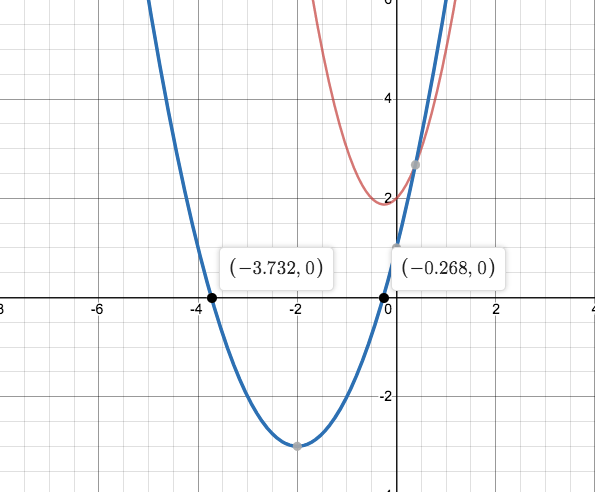
The red graph is
One of the oldest problems in mathematics is how to find roots of polynomials. Indeed, there used to be competitions with big monetary prizes for who could compute roots the fastest, and if you found a general formula for the roots (like the quadratic formula), you became famous in the math world. There are actually formulas when the degree is 


What I now describe is not a method to find real roots, but rather a condition which says when real roots do not exist. Let’s look at two more polynomials with their graphs.
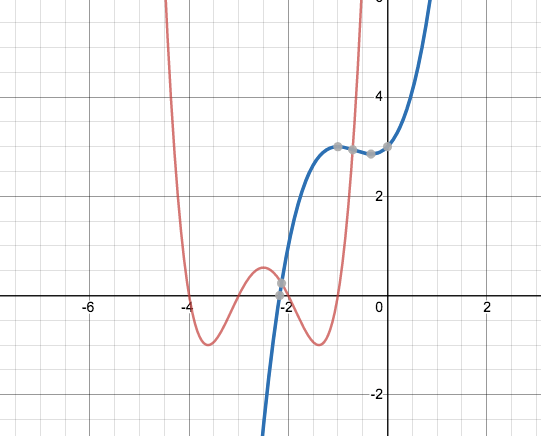
The red graph is the graph of

and the blue graph is the graph of

The numbers in front of each power of 

Notice that the red graph crosses the 

Now here is the fascinating fact: I could have told you that

There are too many inequality switches for this polynomial to have all real roots. Earlier we saw that the quadric 

Compare this to the sequences of coefficients of

This is an example of a unimodal sequence of numbers; more generally, a unimodal sequence of numbers increases up to a peak (in this case, 
We can now state the Main Theorem:
Theorem: If the sequence of coefficients of a polynomial is not unimodal, the the polynomial has non-real roots. Said differently, if all the roots of a polynomial are real, then the sequence of coefficients is a unimodal sequence.
The rest of this post gets pretty formal.
Before we start, let’s define one more thing: the derivative. This term is essential in calculus, and instead of going in depth, I’ll just say what it is for a polynomial: the derivative of a polynomial 


we get

If we did this again, we would call it 


The Main Theorem with Proof
First we formalize a term mentioned above and then re-state the Main Theorem. Let 


then we say that the sequence is unimodal.
Theorem: Let

are real, then
This theorem is proven by the following three steps.
Proposition 1: If all roots of

are real, then 
Corollary 2: If all roots of

are real, then
Lemma 3: If
Proof of Lemma 3: Suppose 


Applying this argument inductively, we obtain the result.

Proof of Corollary 2: As the name suggests, this proof depends on Proposition 1, which we are proving next. Assuming its truth, we define a new sequence 

Then

has all real roots, so 
Proof of Proposition 1: An application of Rolle’s Theorem is that if a polynomial has all real zeros, then so does all of its derivatives. Then

has all real zeros, which implies

has all real zeros, which implies

has all real zeros. This last polynomial is the quadric

which has zeros only if the discriminant 

I learned of these proofs from Stanley in this paper.
 Jesse Keyton